By Textiles for SDGs
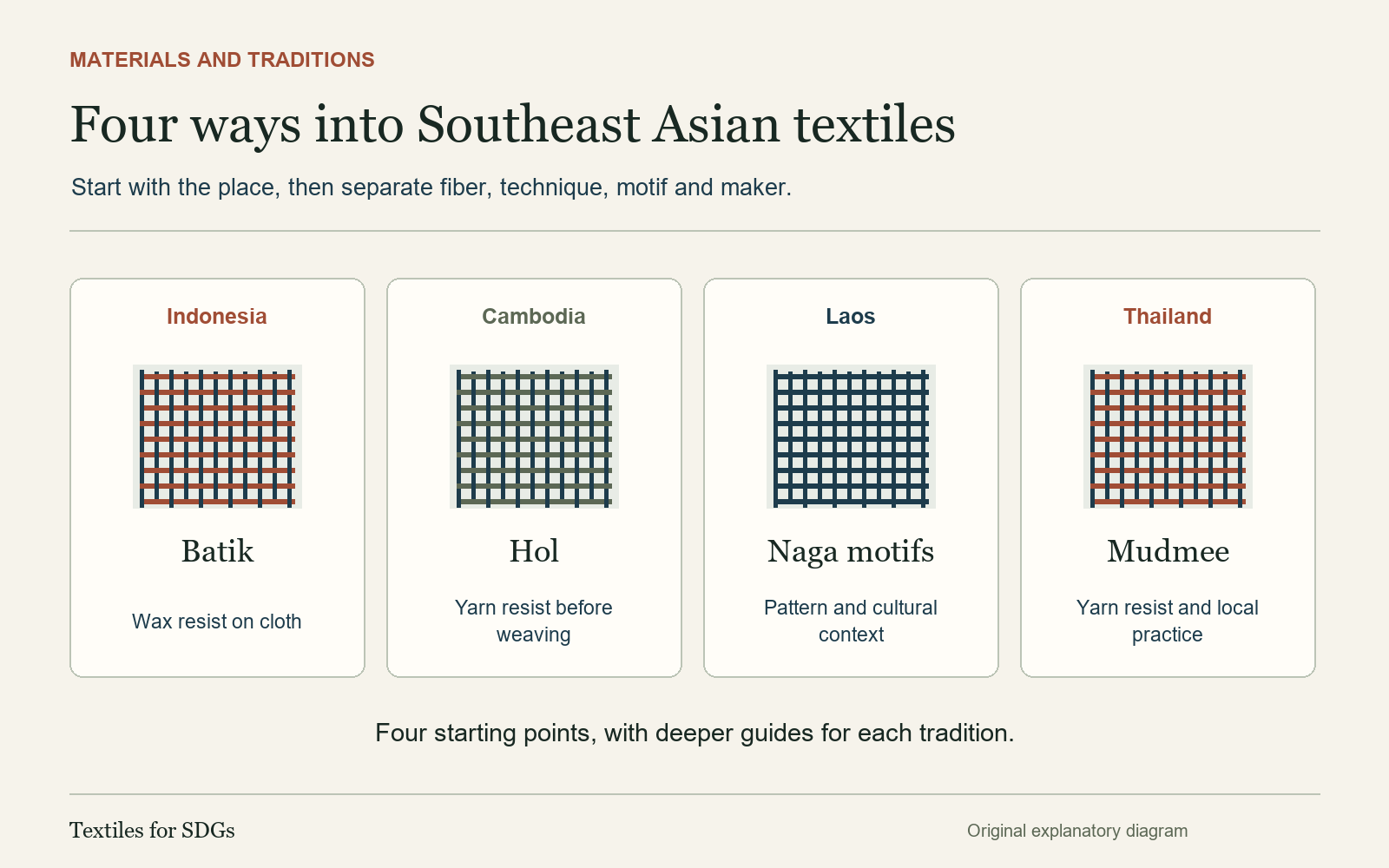
A textile description can name a fiber, a method, an object or a motif. Those are different answers. This guide starts with four documented examples from Indonesia, Cambodia, Laos and Thailand, then shows where each pattern enters the making process. The examples open a route into the four country guides; they do not stand for every textile made in those countries or across Southeast Asia.
How to use this guide
First ask what is being described. Technique tells you how a design was made. Object tells you what the cloth was made or used for. Motif names a design element, whose meaning may depend on a named community, maker or setting. One word cannot reliably answer all three questions.
A museum’s record can establish the material and method of its own object. It cannot establish how an unrelated textile offered today was made. Use the linked guides to follow each example further, and ask for item-specific evidence when reading a contemporary product description.
The process map: fiber to finished cloth
Yarn preparation
Weaving starts with prepared yarn. How that yarn is made depends on the fiber. The Traditional Arts and Ethnology Centre’s Tai Lue cotton display traces cotton varieties and tools used to prepare and spin thread. That named display is an example of preparation, not evidence that every Lao textile uses the same fiber or tools.
Yarn resist
For ikat, bundles of yarn are bound in selected places and dyed before weaving. Protected sections take less color; the planned arrangement becomes visible as the yarn is woven. The Australian Museum’s ikat explanation distinguishes patterns made in warp threads, weft threads or both.
Weaving
Warp threads run lengthwise on the loom; weft threads pass across them. A pattern can emerge from the placement of previously dyed yarn, from the structure of the weave, or from additional patterned threads. “Woven motif” therefore does not automatically mean ikat.
Cloth resist and embellishment
Once cloth exists, a maker may protect parts of its surface with wax before dyeing, as in batik. A design can also be added to cloth by printing or another surface method. These stages may be combined in one object, so a description should identify the actual process rather than force every textile into a single category.
Pattern timing at a glance
Before weaving: bind and dye selected yarn → weave the yarn into a design. During weaving: arrange threads or structure to form a design. After weaving: apply wax resist and dye, or add a surface design. The sequence tells you more than an isolated pattern photograph.
Indonesia: batik on woven cloth
In Indonesian batik, wax protects chosen areas of already woven cloth during dyeing. The Australian Museum describes batik tulis, with wax drawn through a canting tool, and batik cap, with wax applied by a copper stamp. A stamp that places resist wax is not the same claim as a colored image printed to resemble batik.
Read the Indonesian batik guide for a named museum object and the difference between a making method, a design’s setting and an unsupported production claim.
Cambodia: hol and weft ikat
The Textile Museum of Canada records a Cambodian sampot hol waistcloth, dated 1900–1930, as silk with weft ikat and twill weaving. Its pattern was made in the weft yarn before weaving. That object record is more precise than calling every patterned Cambodian cloth simply “ikat.”
A pidan is a different kind of object. The National Gallery of Victoria records a nineteenth-century Cambodian pidan hanging in silk weft ikat and explains its temple context and narrative imagery. The two records share a technique but describe different uses. The Cambodian hol guide follows that distinction.
Laos: Naga motifs in woven cloth
“Naga” names a motif and cultural subject, not a single fiber or a synonym for yarn resist. The Traditional Arts and Ethnology Centre identifies one Tai Daeng Naga wall hanging as woven silk and describes its subject as a water serpent. That is a named producer’s description of an item, not a definition of every Lao Naga cloth. The Lao Naga guide considers motif and cultural setting in more detail.
That separation prevents a common mistake: seeing a serpent-like shape in a photograph and assigning it a fixed meaning or a method of manufacture. A motif can be reproduced by a different process; resemblance alone does not document the maker’s knowledge or the cloth’s history.
Thailand: mudmee and local variation
Thailand’s government mudmee account describes tied, dyed weft yarn woven into a pattern, and says cotton as well as silk can be used. Mudmee thus identifies a process, while “silk” or “cotton” identifies a material. Neither word alone identifies a particular maker.
The Thai mudmee guide examines local variation and a named maker’s record. Its examples are a reason to preserve the source of a pattern name, rather than treating mudmee as one unchanging national design.
How to read a textile description
The table keeps a documented object or source beside the stage of patterning. Each row points to a deeper guide, not to an authentication rule for an unrecorded item.
| Example | When the pattern is made | Documented source | What the record does not settle |
|---|---|---|---|
| Indonesian batik | Wax resist on woven cloth, then dyeing | Australian Museum process account | Method and conditions for an unrelated batik-style item |
| Cambodian sampot hol | Weft yarn dyed before weaving | Textile Museum of Canada waistcloth T86.0339 | Maker and supply chain of a present-day waistcloth |
| Lao Naga motif weaving | Woven into a named wall hanging | TAEC Tai Daeng silk wall hanging | Fiber, meaning or maker of a similar-looking item |
| Thai mudmee | Weft yarn dyed before weaving | Thailand government process account | Fiber, local design or pay for a specific cloth |
Technique versus a printed look
“Ikat print” can reasonably describe a print that looks like ikat; it does not assert that yarn was resist-dyed. “Batik motif” names a look but leaves the method open. Ask at which stage the design entered the cloth when the process matters.
Material, dye, maker and place
Record each fact in its own field. A cloth may be woven in one place using yarn obtained elsewhere. A technique name does not tell you whether a dye is plant-derived, whether a named maker did every stage, or whether a stated place is a design reference rather than a production location.
Four words worth keeping distinct
Warp: lengthwise loom threads. Weft: threads crossing the warp. Resist: a binding or applied substance that protects selected areas during dyeing. Motif: a repeated or recognizable design element; its interpretation needs context.
What the technique does not prove
A documented method does not establish fair payment, safe dyeing, low water use or the origin of every input. Nor does a photograph authenticate an individual item. For decent work, ask who performed each stage and what is known about their terms and payment. For responsible production, ask what records cover materials, chemicals, waste and product use.
Start a purchase or collection note with what can be verified: fiber composition, named maker or workshop, place, process and the source for each statement. The materials guide helps separate a label from a wider impact claim. For a finished textile, use the care guide and the object’s actual condition and instructions rather than assuming that all batik, ikat or silk should be treated alike.