By Textiles for SDGs
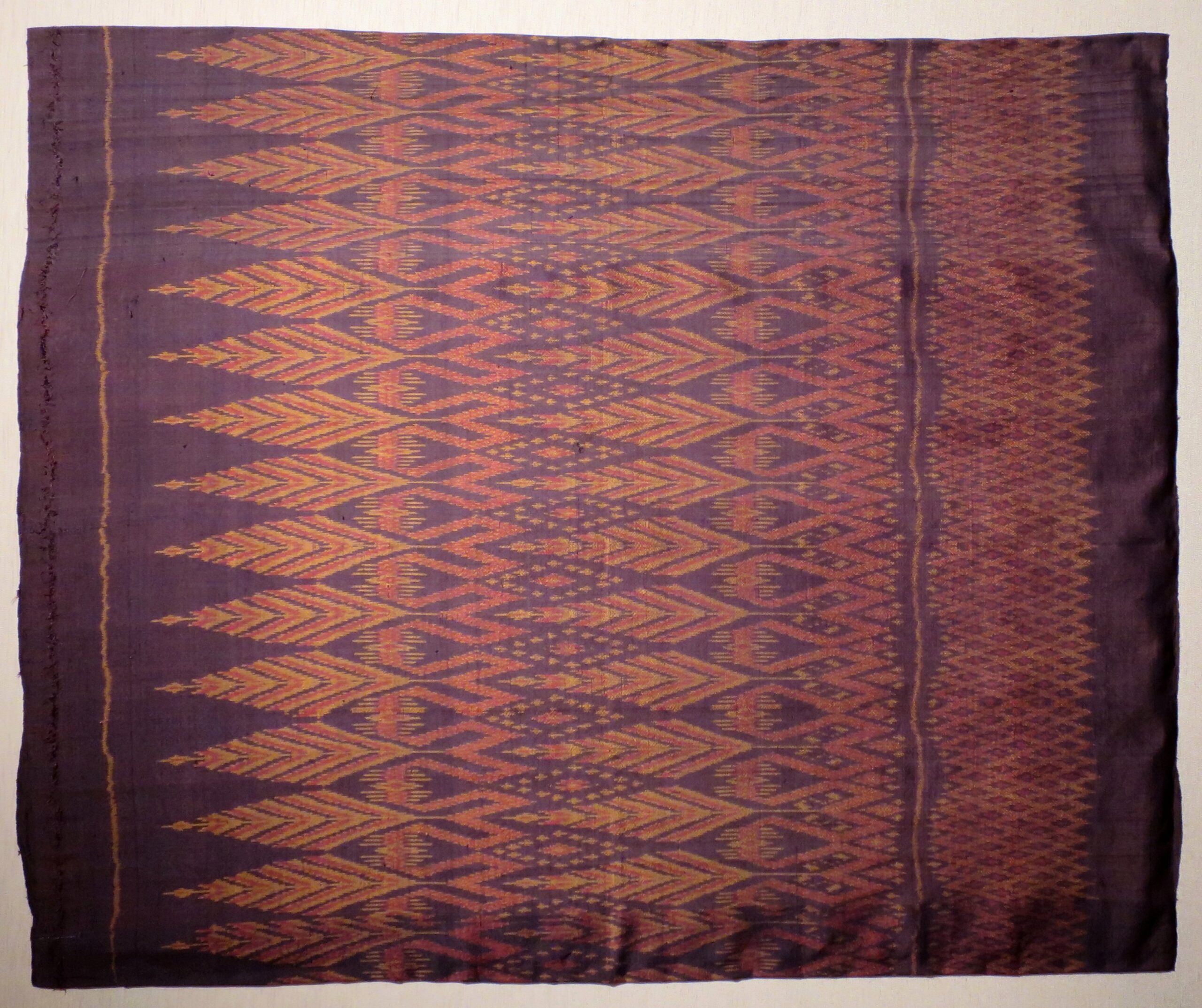
Mudmee is a way of making a pattern in yarn before weaving it into cloth. It is closely associated with northeastern Thailand, but the name does not identify one fiber, one community or one set of production conditions. Understanding the technique is a starting point for understanding the textile.
The pattern begins before the cloth
In weft ikat, groups of weft yarns are bound in selected places before dyeing. The bindings resist the color. When those yarns are woven across the warp, their colored and protected sections form a design. Thailand’s government introduction to mudmee describes this sequence and notes that the technique can use cotton as well as silk.
Silk therefore describes a material; mudmee describes a patterning process. An ikat-like print on finished cloth may resemble the result, but it follows a different sequence. A useful description should say whether the yarn was resist-dyed before weaving, rather than relying on the appearance of the pattern.
Look for the particular maker and place
Regional names help locate a textile, but they do not make every cloth within a region identical. A 2024 study by Khunyarin Chaijan compared mudmee silk in Chonnabot, Khon Kaen, and Khwao Sinarin, Surin. Drawing on interviews, observation and documentary research, it found patterns connected to local environments, beliefs and ways of life, alongside differences in weaving practice.
The study concerns those places. It is not a guide to interpreting every Thai motif. When a seller assigns a meaning to a design, ask whose interpretation it is and which community or maker the account refers to. Recording a pattern name with its source preserves more information than describing it simply as “traditional.”
Traditional does not mean unchanging
A specific object can reveal decisions that a broad category conceals. SACIT’s archive records a Sangsan-pattern mudmee textile by Kru Eam, with animals, plants and landscape imagery. Its account describes designing on graph paper and combining resist-dyeing with color painted onto the yarn. It identifies silk, a twill structure and chemical dyeing materials.
This record gives the maker an active role in design. It also provides a useful check on assumptions: a documented traditional craft can include chemical dyes and experimentation. That does not establish a particular environmental outcome. It does show why “handwoven” and “naturally dyed” should be treated as separate claims.
Connect the craft to the work
The Queen Sirikit Museum of Textiles’ Woven Dialects account describes how the SUPPORT Foundation has provided training, materials, design support and a market for rural craft production. The museum places these textiles within regional knowledge and opportunities for income.
Such an account explains an organization’s approach. It does not establish the pay or working conditions behind an unrelated product. For a particular cloth, ask who carried out the tying, dyeing and weaving, how the work was commissioned, and what information is available about payment and safety. These are practical questions behind SDG 8 and decent work.
Read material and environmental claims separately
A place of weaving is not necessarily the source of the yarn. A dye name is not a record of water use or waste treatment. A handmade label is not a measure of how long a finished garment will remain useful.
Four useful checks
- Confirm the fiber composition of the warp and weft.
- Ask where the yarn was prepared, dyed and woven.
- Trace claims about dyes, working conditions or waste to records for those stages.
- Keep the maker’s care instructions with the finished textile.
These checks follow the concerns of SDG 12, including resource use and the management of chemicals and waste. They do not turn a craft name into a sustainability rating. Our materials guide explains how to read the scope of a claim; the care guide starts with the needs of the actual item.