By Textiles for SDGs
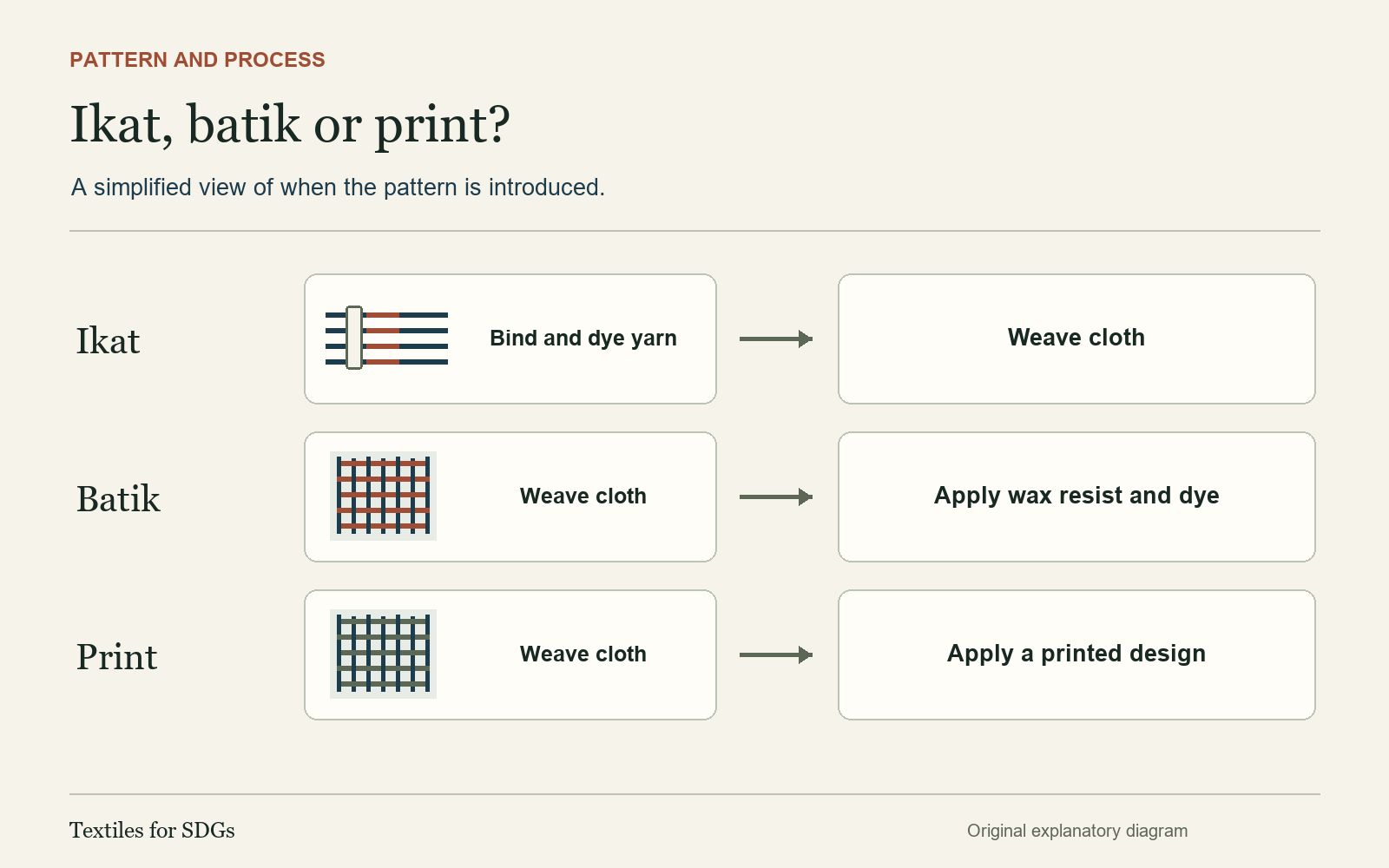
The useful difference is when the pattern enters the textile. In ikat, selected yarn is bound and dyed before weaving. In batik, wax protects areas of an already woven cloth during dyeing. In a print, a design is applied to cloth. These descriptions explain processes; they do not, on their own, identify a particular item’s maker, fiber or working conditions.
The short answer: three routes to a pattern
Think of the sequence. Ikat: pattern the yarn, then weave it. Batik: weave the cloth, apply wax resist, then dye it. Print: weave or otherwise make the cloth, then transfer a design onto it. Some textiles combine methods. A maker might print a resist onto cloth before dyeing; “printing” by itself does not specify the colorant or every later step.
Follow the pattern
Yarn → resist and dye → weave: ikat. Cloth → wax resist → dye: batik. Cloth → apply a design: print. The diagrams describe the main distinction, not every possible finishing or repeat-dye stage.
What ikat names
Tie and dye yarn before weaving
The Australian Museum’s ikat process account explains that bundles of yarn are selectively tied, dyed and arranged so their colored sections form a design on the loom. Repeated binding and dyeing can build several colors. The pattern is planned before the yarn becomes cloth, even though the final alignment happens during weaving.
Warp, weft and double ikat
Warp threads run lengthwise on the loom; weft threads pass across them. In warp ikat, the warp is resist-dyed. In weft ikat, the weft is resist-dyed. In double ikat, both sets are patterned before weaving. These are versions of the method, not grades of quality. The museum describes all three; the Textile Museum of Canada identifies a Cambodian sampot hol waistcloth specifically as weft ikat. Thailand’s government also describes mudmee as weft ikat. Read the Cambodian hol and Thai mudmee guides for the object and local context behind those terms.
What batik names
Batik uses wax as a resist on already woven cloth. Waxed sections are protected from dye; removing the wax reveals the pattern. Repeating the wax and dye stages allows more complex color arrangements. The Australian Museum’s batik account describes tulis, with wax drawn using a canting tool, and cap, with wax applied by copper stamps. A cloth can combine the two.
Those names classify how the wax was applied. They do not name a fiber or a universal design. A copper stamp that applies resist wax is also different from a stamp that directly prints a colored motif. The Indonesian batik guide follows documented objects and their design contexts rather than treating every batik as one style.
What “printed” can mean
A print transfers a design to cloth. It may reproduce the blurred outline associated with ikat or the shapes of a batik design without using either resist-dyed yarn or batik wax. Printing is not necessarily digital or machine-operated. The Metropolitan Museum of Art describes block, roller and other printing methods for textiles. Its discussion also shows why “printed” needs a little precision: some blocks apply dye, while others can apply a resist or mordant before a later dye bath.
A clear product description therefore says what was applied and when, rather than using “print” as a judgment about authenticity. An ikat-style print can be an accurately named product. It simply makes a different process claim from yarn-resist ikat.
A side-by-side process table
| Method | Pattern stage and substrate | Mechanism | Possible clue | Limit |
|---|---|---|---|---|
| Ikat | Before weaving, on warp, weft or both | Selected yarn areas resist dye; patterned yarn is woven | Small shifts where patterned threads meet | Skilled alignment can be close; a print can imitate shifts |
| Batik | After weaving, on cloth | Wax resists dye; wax is later removed | Variations in drawn or stamped wax lines | A print can copy those marks; wax methods vary |
| Printed design | After cloth is made, on its surface | Design is transferred by a named printing method | Regular repeat or different color on the reverse | Print techniques and cloth structures vary; appearance is not decisive |
These clues are prompts for questions, not tests that authenticate an item.
What you can and cannot learn by looking
Examine both sides and the edges if you can. Do colors follow individual yarns? Does the design repeat with exactly the same small marks? Are there shifts between rows of weft? Such observations can help you ask whether the pattern was made before or after weaving.
None is conclusive alone. The Australian Museum notes that ikat yarn can be aligned with considerable precision. Batik wax can be stamped regularly, while a print can deliberately reproduce irregular lines or crackle. Reverse-side color depends on the dye or printing method and cloth construction. A photograph may hide those details entirely. For a consequential claim, prefer a maker’s account, production records or a museum’s object-specific attribution over a visual rule of thumb.
Descriptions that mix terms
- “Ikat print”: normally describes an ikat-like design printed on cloth. Ask whether the yarn was actually tied and dyed if the process matters.
- “Batik motif”: describes the visual reference. It leaves open whether wax resist, printing or another method made the item.
- “Hand-stamped batik”: suggests wax applied by hand with a stamp. Ask whether the stamp carried wax resist and whether the listing identifies the maker or workshop.
For any label, separate the fiber content, patterning process, place and maker. A place name may refer to a design tradition rather than the place where this item was dyed or woven. A named technique may describe one stage while other stages were performed elsewhere.
Materials, care and production questions
Neither ikat nor batik is a fiber. Cotton, silk and other fibers can require different handling, while dyes, finishes, age and condition add further limits. Start with the finished item’s instructions; the care guide explains how to approach uncertain or fragile textiles. The materials guide helps read a fiber claim alongside the stages it leaves out.
Likewise, a method does not demonstrate fair pay, safe work, low water use or good waste treatment. Ask who prepared the yarn or cloth, applied dye or wax, wove or printed the design, and what evidence covers those stages. Those questions connect to SDG 8 and SDG 12. A technique is a useful description of making; an impact claim needs a separate record.