By Textiles for SDGs
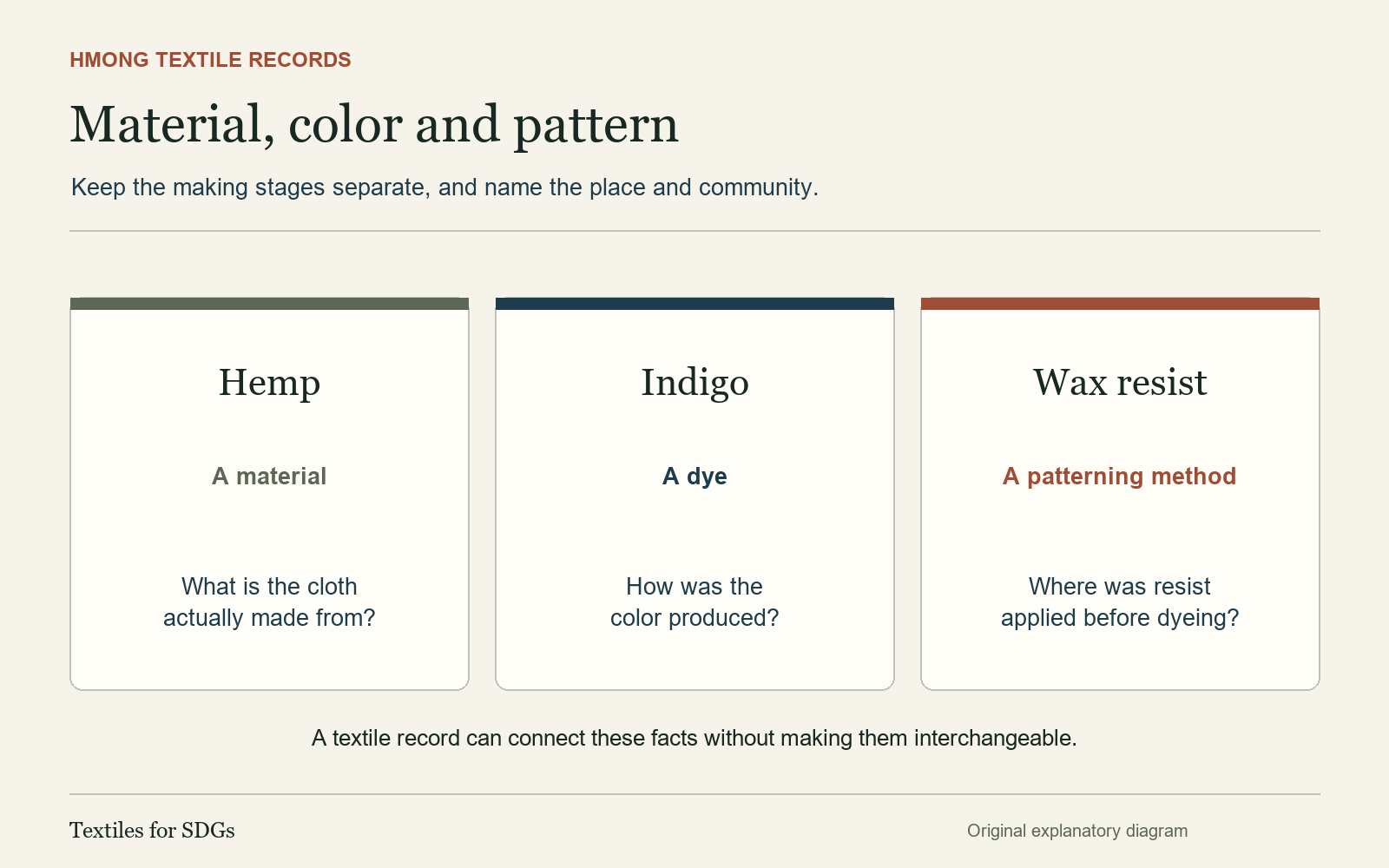
Hemp, indigo and wax resist describe different parts of a textile. Hemp can supply the yarn and cloth; indigo can color it; wax can protect a drawn pattern during dyeing. This guide compares two documented places in northern Vietnam: a Blue Hmong account from Pa Co and a Flower Hmong cooperative in Lùng Tám. Neither account describes every Hmong maker or every item sold under a Hmong textile label.
What this guide covers
Community and place are part of a useful textile description. Supei Ho’s field account for The Textile Atlas describes Blue Hmong textile work in Pa Co, in the Hòa Bình area. The official Viet Nam National Authority of Tourism describes Lùng Tám Linen Co-op, run by Flower Hmong makers in Quản Bạ, Hà Giang. These are different communities and production settings. A procedure documented in one should not automatically be assigned to the other.
Ho’s account is not dated by year on the page. Its observations of market goods and household work describe that visit, rather than a current survey. The official Lùng Tám pages describe a named cooperative; they do not verify the origin of an unrelated shop’s product.
Hemp is the fiber, indigo is a dye, wax resist is a method
Hemp comes from the plant stem and can be prepared into yarn. Weaving interlaces that yarn into cloth. Indigo is a blue dye source and process; saying “indigo” does not identify the fiber underneath. For wax resist, a maker draws or applies wax to areas of an existing textile before dyeing. The protected areas take less color, and removing the wax reveals the design.
These stages can appear together, but each needs its own evidence. A hemp textile need not be indigo-dyed. A blue textile need not be hemp. A batik-like pattern may be printed rather than made with wax. The Indonesian batik guide explains another documented wax-resist tradition; similarity in broad method does not make the two traditions interchangeable.
A documented Pa Co account
Ho describes Pa Co as a Blue Hmong majority village. In that account, households grow hemp and indigo alongside other crops, and textile making takes place around other household work. The account describes handwoven hemp cloth, indigo batik, patchwork, cross-stitch and appliqué. Those are linked but separate forms of work: growing plants does not itself weave cloth, and a stitched decoration does not establish how the ground fabric was dyed.
Ho also reports seeing printed polyester skirts among goods at the Pa Co market, alongside fewer handmade batik pieces and rolls of handwoven hemp. That is a particular observer’s market account. It cannot establish today’s stock mix or the fiber content of an individual skirt. It does make a practical point: community association, motif and sales location do not replace an item-specific material and maker record.
A separate Hà Giang example: Lùng Tám
The Viet Nam National Authority of Tourism identifies Lùng Tám Linen Co-op as a Flower Hmong enterprise in Quản Bạ, Hà Giang. Its travel account describes community-grown hemp that is prepared, plant-dyed and handwoven at the workshop. A second Tourism Information Technology Center account says the cooperative began in 2001 and describes peeling, pounding, spinning, loom work and cloth flattening. The Ministry of Industry and Trade’s 2024 listing locates the cooperative in Hợp Tiến hamlet, Lùng Tám commune, and names woven cloth among its products.
Those official accounts establish a named hemp-weaving case. Their English pages also use “linen” and “flax” for lanh while another official page explicitly says “hemp.” For an individual product, that translated term is not a fiber test: ask the cooperative or seller for a precise composition. The accounts do not document an indigo vat or wax drawing for every Lùng Tám piece. A plant-dyed product from this workshop should not automatically be described as indigo batik.
Preparing and weaving hemp
Preparing stem fiber is labor before the loom. The Lùng Tám tourism account names growing, harvesting, peeling, pounding and spinning among its stages. It says experienced artisans handle the handloom and manage broken threads. The exact sequence and division of work for a particular piece still need a maker’s record; an institutional overview cannot tell us who did every task in one order.
Pa Co’s field account, meanwhile, describes household-grown hemp and handwoven rolls of cloth, without a detailed timed inventory of every preparation step. Together the records show why “handmade” is broad. “Handwoven” identifies loom work. It does not by itself confirm that the fiber was grown locally, spun by hand, dyed with indigo or decorated with wax.
Wax drawing and indigo dyeing
In the Pa Co account, indigo batik is part of the Blue Hmong textile practice described. Conceptually, the ground cloth must exist before wax can reserve a pattern on it; dyeing then colors the unprotected areas. A record of indigo batik identifies a patterning process, not a vat recipe. For a particular cloth, the dye ingredients, dipping sequence and wax-removal method need the maker’s account.
A finished dark-blue surface does not prove that an indigo plant was grown nearby, what ingredients entered the vat, how many dye cycles were used or where dye water went. Similarly, a pale motif on blue cloth can suggest a resist process but does not authenticate an item from a photograph. Ask what stage the maker performed and what record supports that description.
How to read a textile claim
| What you notice or read | Possible explanation | What remains to verify |
|---|---|---|
| Uneven blue color | Variation in dye application or wear | Dye source, bath inputs and maker |
| Pale design on blue cloth | Wax resist or another pattern method | Process record for this item |
| “Handwoven hemp” label | A claim about loom work and fiber | Fiber composition, workshop and who wove it |
| Hmong-style skirt at a market | Design or dress association | Material, origin, maker and whether the motif is printed |
Ask for the community and village, maker or cooperative credit, fiber composition and the stages actually done by hand. A seller’s answer may be partial; recording that limit is more honest than filling it with a generalized story. Keep any care instructions with the specific item, especially when its dye, trims or backing are unknown. Our care guide begins with the item’s condition and available instructions.
Work, continuity and environmental evidence
Textile making can involve crop tending, fiber preparation, weaving, wax drawing, dyeing, sewing and selling. These tasks may occur around other paid and unpaid work. The two place accounts show craft activity, but neither provides a current pay record covering all workers and stages. A claim about fair payment needs the cooperative or maker’s account of terms, piece rates or time, input costs and who controls sales. Those questions connect to decent work without treating heritage recognition as proof of wages.
Likewise, hemp and plant dye names are descriptions of inputs, not a lifecycle verdict. Ask where the fiber grew, what was used in dyeing and finishing, how wastewater was handled, and what comparison an environmental claim uses. The responsible production guide explains why the boundary matters. The materials guide can help keep fiber, process and outcome claims apart. A good provenance note gives both communities room to describe their own work instead of turning one regional label into a blanket guarantee.