By Textiles for SDGs
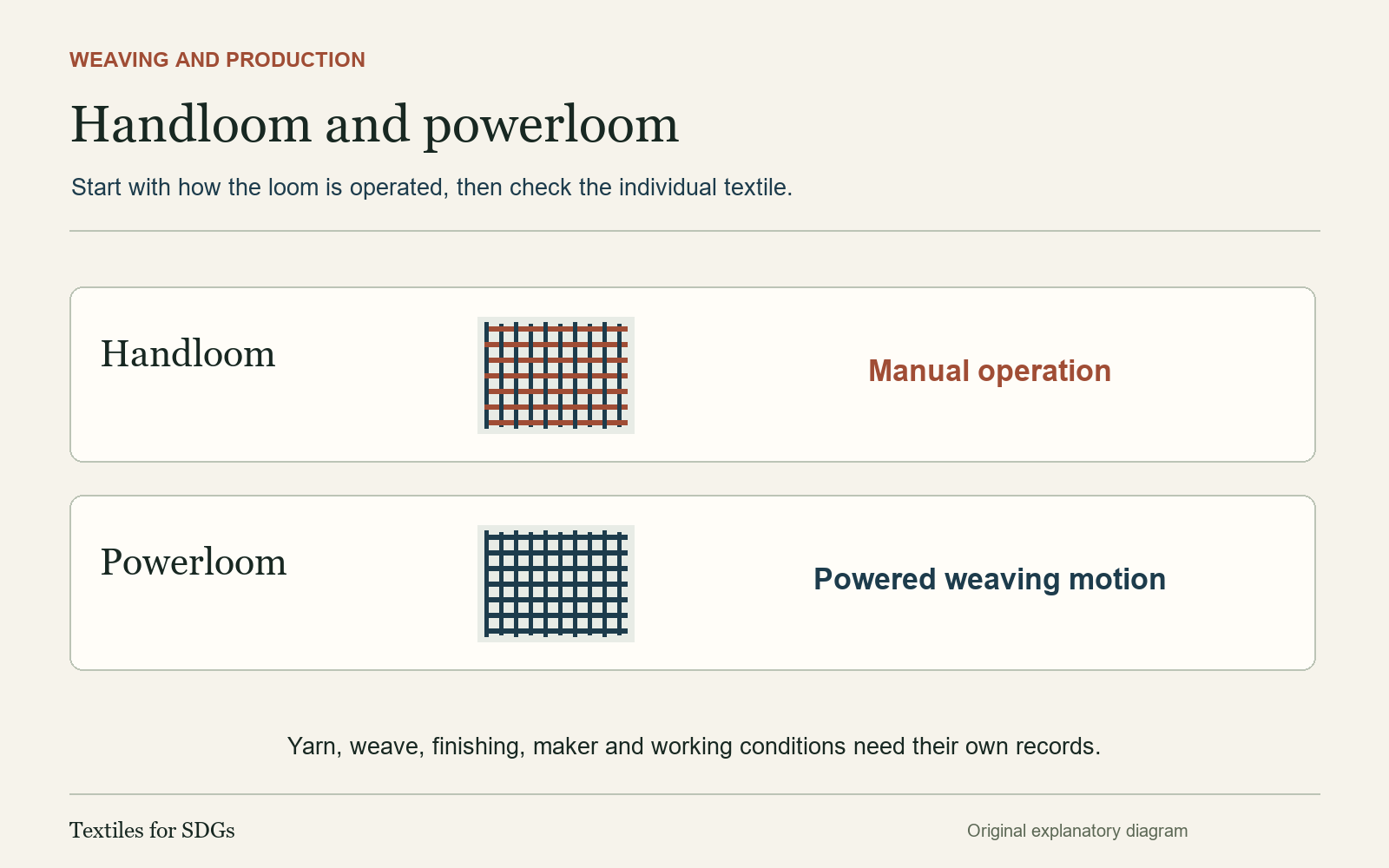
A handloom and a powerloom both interlace yarn to make woven cloth. The difference is how the loom’s weaving motions are driven: by the weaver without powered drive, or by a powered mechanism. That distinction tells you something about production. It does not, by itself, tell you the fiber, the quality, the maker’s pay or the environmental impact of a particular fabric.
The difference in one paragraph
On a handloom, a person supplies the motion that operates the loom. On a powerloom, a powered drive moves the weaving mechanism; people still set up, monitor and maintain it. India’s Ministry of Textiles draws the distinction by whether power aids loom operation. Local laws and labels need checking in their own jurisdiction. Neither term identifies the fiber or pattern.
What happens on a loom
Warp and weft
Warp yarns run lengthwise under tension. Weft yarns cross them, usually one passage at a time. Their interlacing forms the cloth. A loom also releases more warp and advances the woven fabric as work continues. Cotton Incorporated’s weaving guide describes these functions.
Shedding, picking and beating
First, selected warp yarns separate to make an opening, or shed. Next, a weft yarn passes through it; this is often called picking. Then the weft is pushed toward the woven edge, or beaten into place. The sequence repeats to build the weave. A shuttle is one way to carry weft, but powered looms can use other insertion systems.
How a handloom is operated
A weaver may use foot treadles to lift groups of warp yarns, pass a shuttle by hand or operate a hand-powered mechanism, then move a beater to settle the weft. Other handlooms are arranged differently. The Metropolitan Museum of Art’s tapestry account, for example, describes both upright and horizontal looms, with a weaver moving the weft through successive sheds. That example shows why a single picture of a floor loom cannot stand for all handweaving.
Hand operation can involve choices about tension, spacing, color and pattern. It can also use aids that organize a design. Calling a fabric handloom does not mean spinning or dyeing was done by hand.
How a powerloom is operated
A powered drive repeats loom motions while an operator attends to yarn supply, settings, stoppages and the cloth. Yarns must be threaded in the right order, tension controlled and faults addressed. Cotton Incorporated’s guide describes the precision required in loom preparation and different systems for inserting weft. A machine’s motion does not remove the need for textile knowledge.
Powerlooms can make patterned as well as plain cloth. The Met’s history of European textile production traces how powered weaving expanded from early plain fabrics to varied patterned fabrics. A complex motif therefore cannot prove a fabric was handwoven. Nor does a simple weave prove it was machine woven.
What a finished cloth may show
Uneven spacing, a change in a border, or a distinctive selvedge can prompt a useful question about how a cloth was made. None is a universal handloom test. Yarn thickness, weave structure, pattern changes, finishing and later wear can all affect what the eye or hand detects. A carefully controlled handwoven cloth may look regular; a powerloom can produce variation, especially when yarn breaks or settings change. The reverse side can reveal how a pattern is built, but it cannot identify the loom’s source of motion by itself.
| Question | Handloom | Powerloom |
|---|---|---|
| What drives weaving? | The weaver operates the loom without powered drive. | A powered mechanism moves the loom. |
| What does a person do? | Operates and adjusts the weaving, with tasks varying by loom. | Prepares, sets, monitors and maintains the equipment; tasks vary by workplace. |
| What might the cloth show? | Variations may be visible, but regularity is also possible. | Regular repeats may be visible, but variation is also possible. |
| What best supports an item claim? | A named maker or workshop, loom information and item-linked records; an applicable, verifiable scheme label can add evidence. | |
Weight, softness, drape and price are also poor standalone tests. Fiber, yarn, density, finishing and sales arrangements influence them. If you are choosing between two fabrics, compare the actual construction, intended use and care needs before deciding which suits you better.
A better check for a specific item
Ask the seller who wove it, where, and on what kind of loom. A workshop record or image showing the identified cloth in production is more useful than an uncaptioned loom photograph. Ask whether the claim covers the whole fabric, a decorative panel or only a later finishing step. If the answer is unknown, keep it as unknown rather than turning a visual guess into an origin story.
Questions to ask a seller
- Who wove this fabric, and where did the weaving take place?
- Was the weaving done on a handloom or a powerloom? What type of loom was used?
- What records connect this item to that maker or workshop?
- Does a named mark apply to this item, and what exactly does it verify?
For Indian products, the Handloom Mark is a Textiles Committee scheme for identifying handwoven products. Its site describes registered users and labels with identifying features. This is an India-specific mark; absence of it does not prove a fabric was powerloom woven. India’s Silk Mark concerns pure silk content, not whether the loom was hand operated. Check the actual label and authorized seller before relying on either claim.
Labor, price and impact are separate questions
Handweaving can require extensive skilled work, but a handloom label does not establish a fair wage. Powered weaving also depends on skilled setup and operation; a powerloom label does not establish pay, safety or the absence of craft. Price can reflect materials, design, time, scale, margins and market position. It is not a wage statement.
Likewise, loom drive alone cannot settle an item’s energy or carbon impact. The yarn, dyeing, finishing, transport, use and disposal all matter. Ask for evidence covering the stages behind a claim. These questions connect to SDG 8 on decent work and SDG 12 on resources, chemicals and waste. The goals frame what to investigate; a weaving label does not demonstrate an outcome.
How the distinction fits these textile guides
Our Thai mudmee guide discusses a weft-ikat tradition that Thailand’s government explicitly describes as handwoven. The source supports that description of the tradition; it cannot verify every contemporary item sold as mudmee. By contrast, a pattern name or a country of origin alone does not establish how an individual cloth was woven. Keep the loom claim separate from the patterning method and from fiber content. The materials guide helps with the fiber question, while the care guide starts with the condition and instructions for the actual item.