By Textiles for SDGs
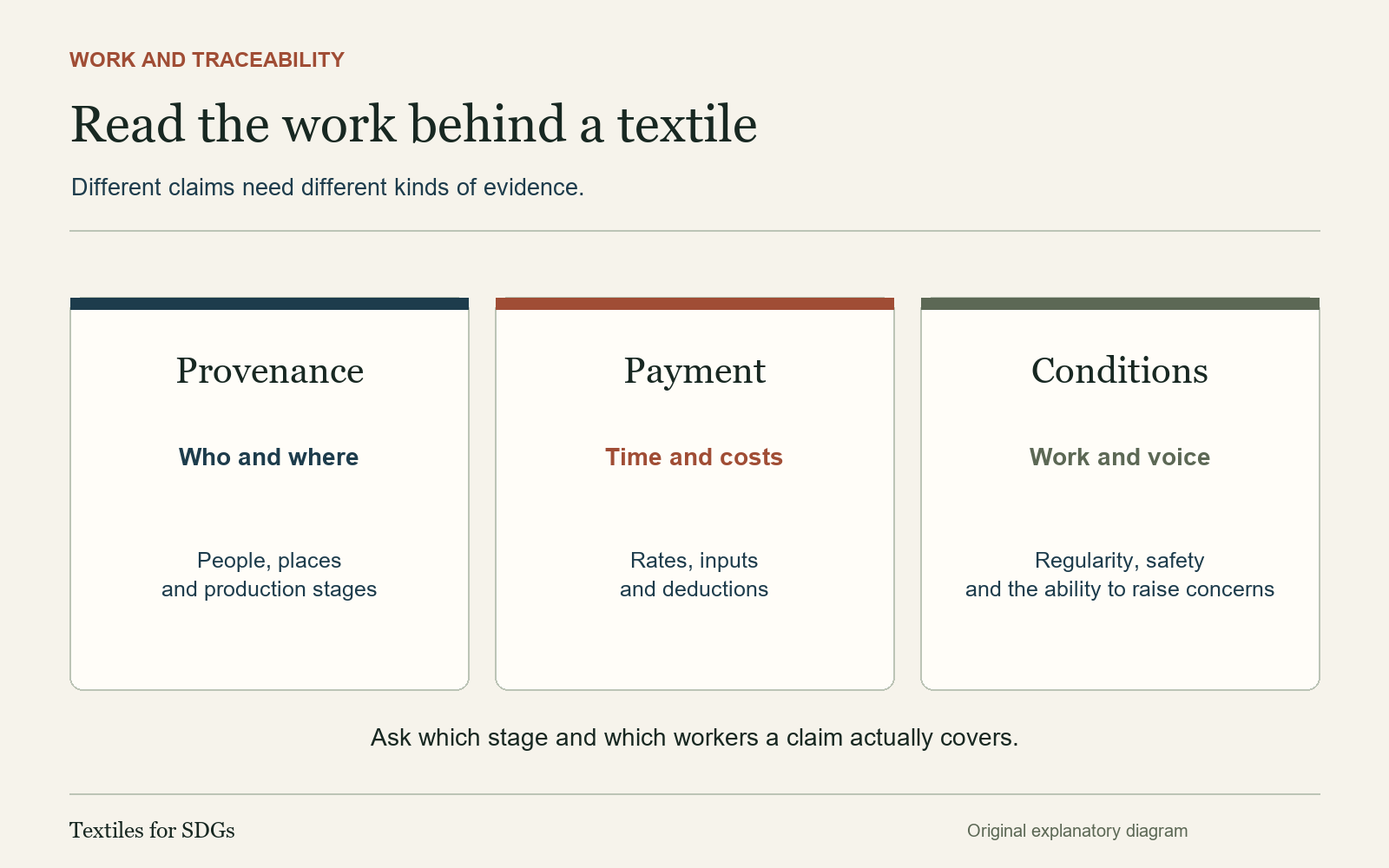
A handwoven textile can be traceable to a place or named maker without showing what anyone earned from making it. Provenance is useful: it can connect a cloth to the people and techniques behind it. A fair-pay claim asks a different question. It needs to show who was paid, for which work, after which costs, and whether the work provided a dependable income.
A textile can be traceable without proving fair pay
“Made by artisans in this village” may establish a production location, if the seller can connect that statement to the particular item. It does not say whether the maker bought the yarn, paid a dyer, worked through an intermediary or waited months for the next order. A photograph of a weaver has the same limit. Ask what part of the chain the evidence covers and when it was recorded.
The OECD describes garment and footwear supply chains as spanning formal businesses and informal work, including homeworkers. That sector guidance is a reason to look beyond the final seller; it is not a finding about the pay behind any particular handwoven cloth.
Map the people and stages
Start with the item, then follow its production backwards: who supplied or prepared the fiber, spun or bought the yarn, dyed it, set up the loom, wove the cloth, finished it and sold it? Some steps may be done by one person; others may involve relatives, specialist dyers, a cooperative or an agent. Do not assume the person named in a product story performed every stage.
Our Thai Mudmee guide explains the separate acts of tying, dyeing and weaving yarn. The Cambodian Hol guide also follows patterning before weaving. Those process descriptions help frame questions about work; they do not establish anyone’s earnings.
What fair pay must account for
Count all the work, not only the weaving
A piece rate is a payment per finished unit. To understand what it means, count the time spent preparing yarn, setting up, tying or dyeing, weaving, finishing, delivering and correcting rejected work where those tasks fall to the same worker. Divide the payment attributable to that worker, after their production expenses, by the hours actually spent. If several people share the work or a payment, their time and receipts must be recorded separately. A rate that looks generous per cloth may look different once the full job is counted.
The OECD’s living-wage handbook recommends setting piece rates with realistic production time and worker consultation, including consideration of equipment and material costs. It warns against using only the fastest worker’s output. That guidance does not supply a universal rate for weaving; technique, item, place and contractual relationship all matter.
Check costs, rework and regularity
Ask who pays for yarn, dyes, loom equipment, electricity, transport and failed or rejected pieces. A quoted price may be gross receipts for a self-employed maker rather than wages for an employee. Do not compare those figures without accounting for costs and the worker’s status. The timing of payment matters too: a good rate for one order does not show whether work is available or paid regularly. OECD guidance identifies piece and day rates, volatile orders and delayed payments as risks for unpredictable earnings.
“The artisan sets the price” leaves open whether the artisan can negotiate, decline an order or sell elsewhere. The buyer’s deadlines, changes and payment terms may affect what the maker retains. The OECD asks buying companies to examine their own purchasing practices as part of wage and income due diligence.
Match the claim to its evidence
Each level below answers a narrower question than a blanket promise of “ethical” production. A claim can be useful even when it has limits, provided those limits are clear.
| Claim you may see | Evidence to ask for | What remains unproved |
|---|---|---|
| Maker or place identified | An item or batch record connecting the named producer, production place and stages to the cloth. | Payment, hours and working conditions. |
| Payment method explained | Who contracted and paid whom, piece or time rate, payment timing, and how the price was set. | Net earnings after costs and time. |
| Pay outcome assessed | Worker-level or representative records of hours, receipts, deductions and order frequency, compared with a stated benchmark appropriate to the employment status, place and period. | Whether workers can safely challenge problems or influence terms. |
| Worker voice included | Independent worker or cooperative representation, a safe complaint route, and evidence that concerns led to action. | A permanent guarantee across future orders or other producers. |
Questions a buyer can ask
A seller should be able to explain its method without publishing a worker’s name, personal pay slip or private circumstances. These questions focus on the system behind a product:
- Which people or groups perform yarn preparation, dyeing, weaving and finishing, and which of those stages can you trace for this item?
- Who pays each worker or group, and are payments based on hours, pieces or an agreed purchase price?
- How are preparation time, rework and rejected pieces counted, and who pays for materials, tools and delivery?
- How often are orders placed and payments made? Can makers negotiate terms or decline work?
- What local pay or living-wage benchmark is used, for which place and year, and how are workers or their representatives involved?
- Can workers raise concerns safely, and how are problems corrected?
A clear answer may cover only one workshop or one order. That is more informative than treating a partial record as proof for every producer.
How sellers and cooperatives can show their method
A useful public account states which stages it covers, the period reviewed, how rates are calculated, who supplies inputs and how payments reach makers. It can report ranges or aggregated findings where individual disclosure would be intrusive. Explain who collected the information and whether workers could verify it without pressure. If a group sets prices collectively, describe how members take part and whether intermediaries or buyers can override the decision.
For a living-wage statement, name the benchmark, location, date, normal working hours and method of comparing actual pay with that benchmark. The ILO defines a living wage in relation to a decent standard of living for workers and their families, local circumstances and normal hours of work. A legal minimum wage and a living-wage estimate answer different questions; neither can be assumed from the retail price of a cloth.
For an employee, the comparison concerns wages for normal working hours. For a self-employed maker, explain how net business income is assessed and whether a living-income benchmark is being used. An employee living-wage estimate is not directly interchangeable with a living-income benchmark.
What labels and certificates can establish
A fiber certificate, craft label or audit may document a particular material, process, facility or period. Read its scope before extending it to workers at other stages. The OECD cautions that certifications and audits can capture a point in time and should be combined with worker engagement and ongoing checks. Even a certificate that includes labor criteria does not automatically verify net earnings for every person who worked on an individual textile.
Read the claim through Goal 8
SDG 8 includes decent work and equal pay in target 8.5, and labor rights and safe working environments in target 8.8. They point to more than a maker’s visibility. A named origin is a good opening question; evidence of payment, realistic hours, manageable costs, regular work and worker bargaining is what lets a fair-pay claim be examined.
The materials guide offers the same discipline for fiber and environmental claims: check exactly which part of a textile’s story a record can support.