By Textiles for SDGs
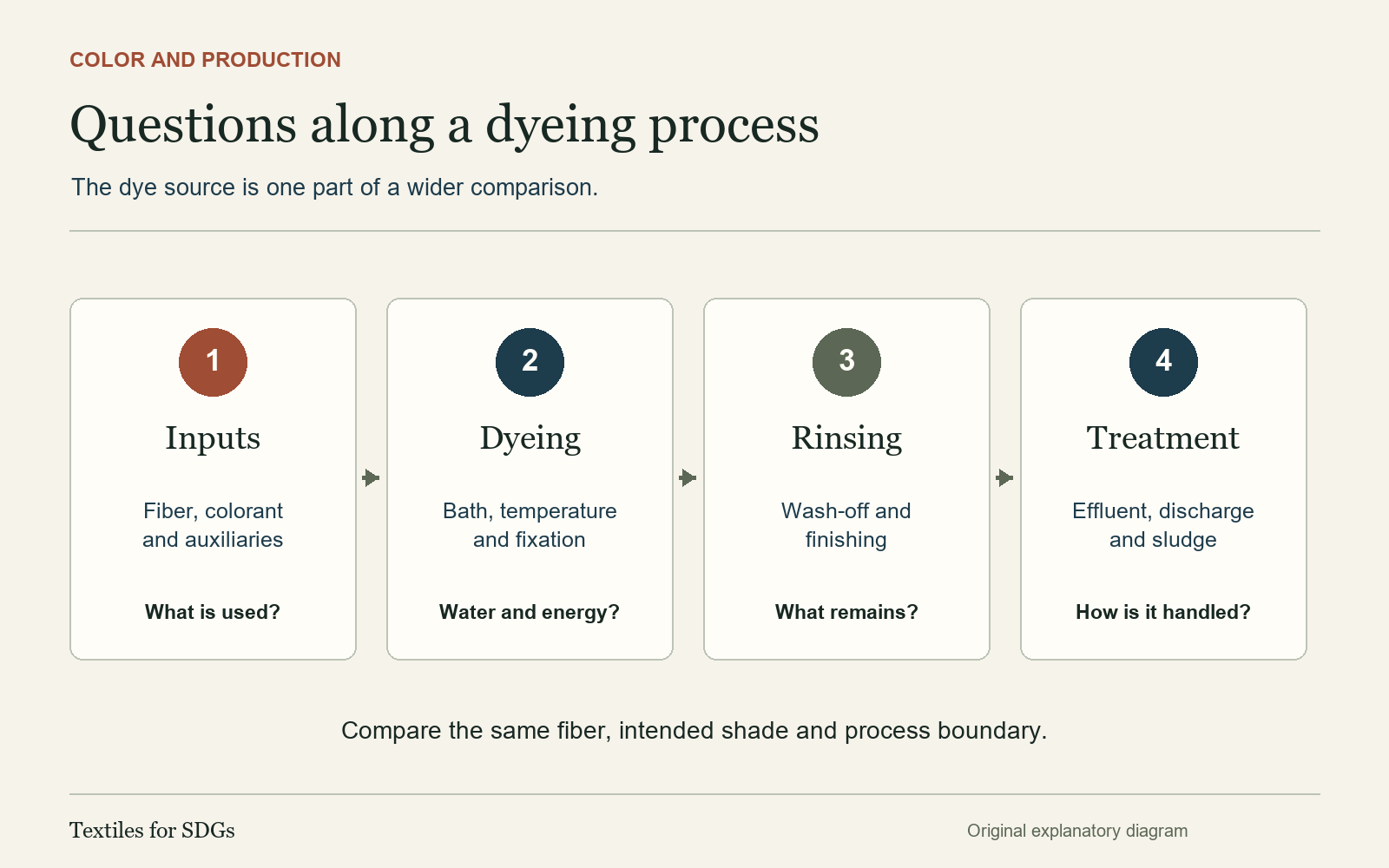
A plant-derived dye is not automatically the lower-impact choice, and a synthetic dye does not describe one uniform process. The useful comparison is between particular textiles: the same fiber and intended shade, with the dyeing recipe, energy, water, wastewater and performance made visible.
What “natural” and “synthetic” describe
Natural identifies a colorant obtained from a source such as a plant or insect. Synthetic identifies a colorant made by chemical synthesis. Neither word tells you how much dye attached to the cloth, what else went into the bath, or what left the workshop in wastewater. “Chemical-free” is especially unhelpful: natural colorants are chemicals too, and a natural dye bath may contain added salts or mordants.
The fiber is a separate fact. Cotton, silk and polyester do not take every dye in the same way. A label saying “naturally dyed silk” identifies a source category and a fiber; it does not measure the environmental result. Our materials guide explains why a product claim needs a stated scope.
Follow the color from source to wastewater
Begin before the dye bath. A cultivated dye plant may require land, irrigation, harvesting and extraction. A colorant recovered from a by-product follows a different route, but collection and extraction still use resources. A synthesized dye has its own manufacturing inputs. For either route, the cloth may be prepared, heated or treated, dyed, rinsed and finished. The water and remaining substances then need appropriate handling.
A useful comparison therefore names its boundary. Does a study count only dyeing inside one facility, or also colorant production, fiber preparation, wastewater treatment and the textile’s use? Does it compare one kilogram of cloth in a similar shade, or two unlike products? A gate-to-gate case study of cotton dyed with Acacia dealbata bark reported lower modeled impacts than its reactive-dye comparison for a similar medium color. That result describes those recipes and the dyeing-stage boundary; it cannot rank all plant and synthetic dyes.
The fiber and dyeing recipe matter together
“Fixation” means how effectively the colorant remains on the textile after dyeing and rinsing. Poor uptake can leave more colorant in the bath or require further processing. The answer depends on the dye and fiber together, not on origin alone. Cotton dyed with a reactive synthetic dye, cotton dyed with a bark extract, and silk dyed with that extract are different systems.
For a concrete example, researchers testing mahogany sawdust extract on cotton measured color strength and fastness alongside residues in the mordant bath and wastewater. The value of that study lies in its specified cotton recipe and measured outputs. It does not show that every waste-derived dye performs alike, or that sawdust extraction has no other burden.
Mordants and other auxiliaries
A mordant helps some dyes bind to a fiber and can change the shade. Other auxiliaries may adjust acidity, assist uptake or help with washing and finishing. These ingredients can matter as much as the named dye. A natural-dye recipe is not necessarily free of manufactured inputs; a synthetic-dye recipe is not necessarily the same as another synthetic recipe.
Check the substance and the amount
In a cotton experiment using banana floral-stem sap, researchers tested metallic mordants, colorfastness, remaining metals in the bath and dyeing wastewater, and trace metals on the cloth. Mordant choice improved some performance measures while creating a separate question about residual metals. Another cotton study of sawdust extract likewise measured metal residues and found that its salt-containing process needed careful effluent management. These are reasons to ask which mordant was used and how residues were handled, rather than to label all mordants safe or all of them equally hazardous.
The OECD’s garment and footwear guidance treats chemical use in wet processing as a supply-chain issue. A brand should be able to identify the substances used at that stage and assess risks there, not rely on a broad “natural” or “eco” tag.
Compare water, energy, land and treatment within the same boundary
Dye baths, heating and rinsing can use water and energy under either approach. Plant growing and extraction can add land and water demands; synthetic-dye manufacture adds upstream industrial inputs. The balance changes with the source, recipe, scale and facility. A shorter bath or lower temperature may help, but the claim needs actual measurements for the process being described.
What happens after dyeing is equally important. Colored water can also contain salts, metals or other process chemicals. The ZDHC wastewater guidelines set out sampling, testing and reporting for wet-processing facilities, including dyeing. A statement that wastewater is “treated” is a start; dated results, the discharge route and sludge handling tell a reader more. Treatment evidence concerns the facility and period tested, not every product from a brand.
Even a well-measured facility cannot settle the whole question if the dye source, energy supply or useful life is omitted. A product-level comparison should state what it includes and what remains outside it. That is also why a dye label alone cannot establish the textile’s climate impact.
Colorfastness and a textile’s useful life
Colorfastness describes resistance to a particular exposure, such as laundering, rubbing or light. These are different tests. A cloth can perform well in one and less well in another. In the banana-sap cotton experiment, light fastness was assessed separately from washing and rubbing, and the results changed with the mordant. Ask for the result and test method that match the item’s likely use. For example, ISO 105-C06 defines laboratory methods for resistance to laundering; it is not an environmental score.
Color that lasts through appropriate care may help keep an item useful, but a good laboratory grade does not prove how long one garment will be worn. Construction, wear, repair and the owner’s needs matter too. Follow the actual item’s instructions in the care guide; do not assume a natural-dyed textile can be washed or treated like another with the same fiber.
In batik and ikat, the technique is another question
A batik pattern is made by applying wax resist to cloth before dyeing. An ikat pattern is made by binding and dyeing selected yarns before weaving. Neither technique says whether the colorant came from a plant or was synthesized. The Indonesian batik guide explains the cloth-resist sequence; the Thai mudmee guide follows yarn resist in a specific tradition. A maker can use a traditional patterning method with a modern dye recipe. Ask about the patterning method and dye ingredients separately.
Questions to ask about a particular textile
Start with what a seller or maker can identify. An incomplete answer is more informative than an unsupported impact rating.
| Claim or question | Evidence that would help |
|---|---|
| “Naturally dyed” or “low impact” | Named colorant source and place; fiber; preparation, extraction and full dyeing recipe; the boundary of any comparison. |
| “Safer chemicals” | Named mordants and auxiliaries, quantities, chemical inventory and the standard or assessment used. |
| “Less water or energy” | Measured use per comparable amount of similarly dyed cloth, including heating, rinsing and any bath reuse. |
| “Clean wastewater” | Facility, treatment route, dated sampling results and how remaining sludge is managed. |
| “Lasting color” | Wash, rubbing or light-fastness results with the test method and care instructions for the finished item. |
When those records are absent, the defensible conclusion is narrow: the dye source may be known, while its impact is not. Goal 12 gives a wider reason to ask about resource use and chemical and waste management, but the answer still comes from the particular supply chain.