By Textiles for SDGs
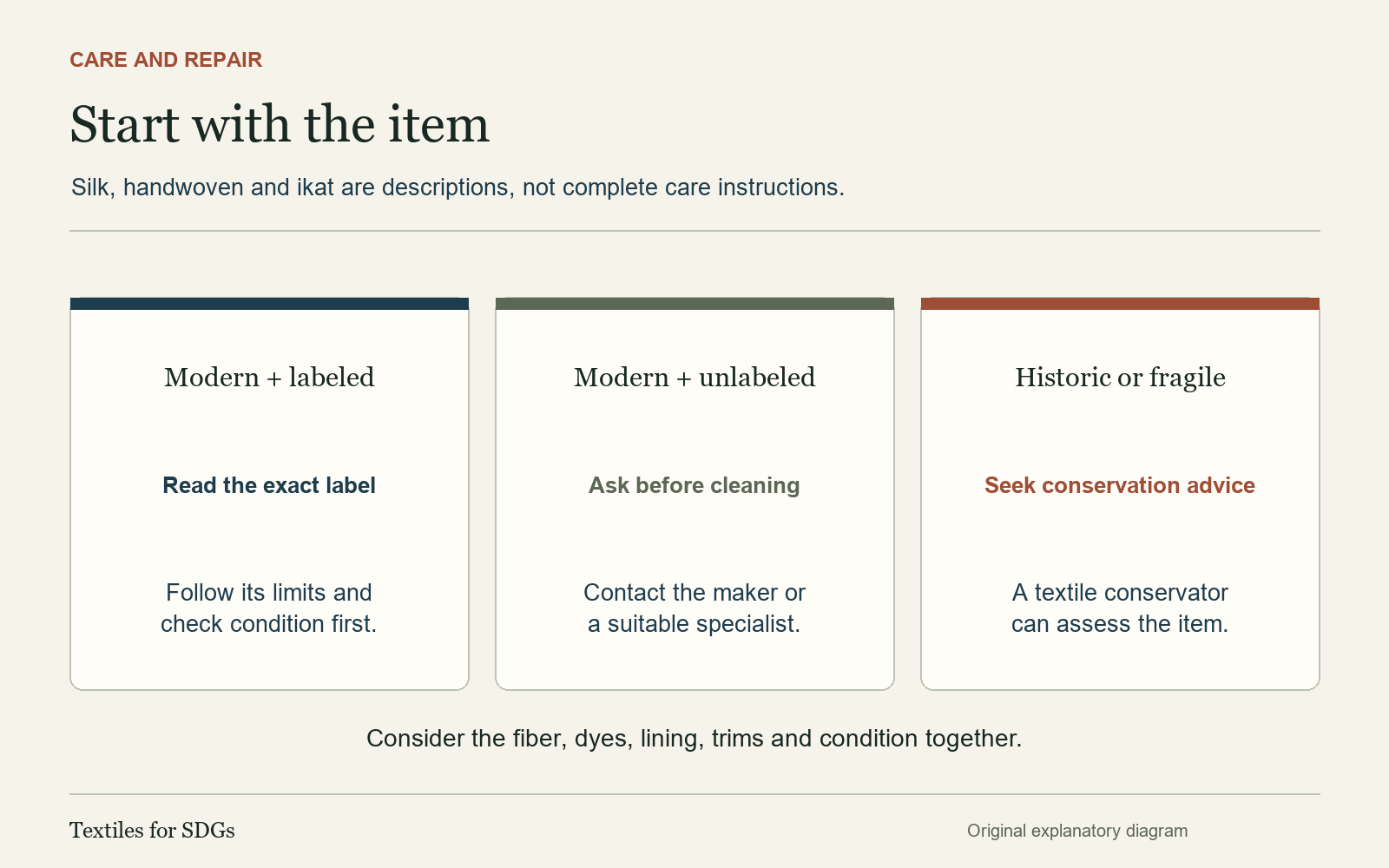
Start with the finished item, not the words “silk,” “handwoven” or “ikat.” A sound modern garment with a washing label, an unlabeled shawl and an older ceremonial cloth call for different care. Read the instructions, check for weak areas and added materials, then choose a route before putting anything in water.
First identify what is in front of you
Ikat describes patterning yarn before weaving; it does not tell you the fiber, dye stability or cleaning method. A silk ikat coat may also contain a lining, embroidery or metal thread. The Cambodian hol and Thai mudmee guides explain traditions, not care for an individual piece.
| What you have | Next step | Water at home? |
|---|---|---|
| Modern item with a readable care label, sound fabric and no conflicting damage | Follow the complete label and any item-specific maker advice. | Only if the label permits washing. |
| Modern item without a usable label, or with unclear instructions | Ask the maker about the finished item; otherwise consult a cleaner experienced with silk and handwoven textiles. | Wait for item-specific advice. |
| Historic, fragile, valuable or culturally significant textile | Limit handling and consult a qualified textile conservator. | Do not wash or spot-test it yourself. |
If a labeled item has bleeding color, torn seams or fragile trim, seek specialist advice first.
Follow the care label and maker’s advice for modern pieces
Read the whole label, including drying, ironing and warnings. “Dry clean only” rules out a home wash; “hand wash” does not mean machine wash. The US Federal Trade Commission explains that care instructions cover the whole garment, including linings and trim. All silk does not automatically need dry cleaning, but a particular garment may.
Keep any item-specific maker directions. If they conflict with the label, ask before cleaning. For an unlabeled modern item, ask its maker whether the finished piece can be washed and how it should be dried and pressed. If the maker cannot answer, consult a cleaner experienced with silk and handwoven textiles.
Check construction and condition before any cleaning decision
Photograph the front, back, label and any damage. Check seams, folds and fringes for splitting or loose yarns. Look for linings, beads, metal thread and previous repairs. Note any color transfer already seen on skin or other fabric. Damage can change which care route is safe.
Ask whether cleaning is needed. Airing a sound modern piece in shade may be enough between wears. For a stain, record where and when it appeared; rubbing one area with water can make matters worse. The general care guide covers routine repair and use.
When to leave water and spot treatments alone
Fragile, old, lined or embellished pieces
Leave a historic or fragile piece dry while you seek advice. The Canadian Conservation Institute’s washing note is specifically about sound, non-colored textiles such as cotton and linen. It says historic silk, fragile or fragmenting cloth, lined garments, trims and composite objects should not enter that washing procedure. Its conservation steps are not a home recipe for a silk ikat.
A home colorfastness test is no shortcut for an old textile. The Institute’s testing note says tests can damage an area and are not foolproof; some historic objects should not be tested at all. Water or stain remover can move dye, leave a ring or disturb a finish. Vinegar and shampoo do not resolve those unknowns.
If a modern label permits washing: work gently and follow its exact limits
First confirm that the item is sound and its instructions actually allow washing. Read whether they specify hand or machine washing, a particular setting, a suitable detergent, washing separately or another warning. Use the stated method and limits; there is no single safe water temperature or detergent for every silk or ikat. If a care symbol is unclear, check the maker’s explanation before proceeding.
For a label that says hand wash, prepare enough water to support the item without crowding it and use a product compatible with the label. Move it gently rather than scrubbing, twisting or leaving it to soak while you do something else. Rinse as directed and lift the wet item with its weight supported. If the water immediately takes on color, a lining puckers or threads begin to shift, stop and ask the maker or a knowledgeable cleaner for advice. Do not attempt to “set” a bleeding dye with an improvised additive.
If the label allows machine washing, follow its cycle, load and drying directions. Do not turn a hand-wash instruction into a machine-wash experiment.
Drying and pressing: protect shape, color and finishes
Follow the label’s drying method. Support a wet item so its weight does not stretch seams or distort the weave; spread it on a clean surface if flat drying is instructed. Keep it away from direct sun and heat when the label or maker calls for shade. Do not store it until fully dry. If you used a professional cleaner, tell them about any unstable color, trim, lining or earlier damage before treatment.
Press only when the instructions permit it. Check the setting and whether a pressing cloth or reverse-side pressing is required. For an older or valuable piece, leave creases alone until a conservator advises. The Canadian Conservation Institute advises against ironing historic fabrics.
Storage and display: support, light, dust and handling
Store a clean, fully dry textile in a stable, cool, dark, ventilated place. The Canadian Conservation Institute’s basic-care guide recommends flat support for most textiles, with acid-free tissue or washed, unbleached cotton to pad unavoidable folds. A sound costume can be hung on a suitably padded hanger, but fragile, heavy or heavily decorated pieces should not hang by weak shoulders. For a large flat cloth, a properly supported archival roll may avoid sharp folds.
Avoid direct contact with ordinary cardboard or wood and the thin plastic garment bags supplied by cleaners. Check storage for insects, dampness and damage. When displaying a textile, avoid direct sun, nails, staples and tape; support its weight. Handle valued pieces with clean hands and jewelry removed. See circularity and reuse for the wider use-life question.
When to contact a specialist, and what information to provide
Contact the maker or an experienced cleaner for a modern unlabeled garment, uncertain dye behavior or conflicting care directions. Contact a qualified textile conservator for an old, fragile, valuable or culturally significant textile, especially if it is torn, shedding fibers, has bleeding colors or includes several materials. A cleaner who routinely handles modern silk is not automatically the right person to treat a historic object.
Send clear front-and-back photographs, close-ups of the problem and any labels, plus what you know of the item’s age, fiber, maker, previous cleaning and current storage. Explain whether it is worn, displayed or kept as an heirloom, and what outcome you want. That record helps the specialist choose a realistic treatment or recommend simply improving support and storage. If you cannot identify the material or condition with confidence, careful storage is a useful next step while you find the right advice.